

Most major contact center platforms have introduced Artificial Intelligence (AI) capabilities. AI copilots assist agents in real time, speech analytics deliver sentiment scoring, automation suggests next-best actions, and dashboards have become more predictive and intelligent.
These are meaningful advancements. Yet across many enterprise and telecom environments, cost-to-serve and escalation volumes continue to rise. This raises an uncomfortable but important question!
Why Is Cost-to-serve Still a Problem in the Age of Enterprise AI?
The answer lies not in the technology itself, but in where and how it has been applied.
In most organizations, AI has been layered onto a contact center architecture that was never designed for the level of innovation, scale, and simplicity we expect today. Real transformation requires the model to be redesigned, realigned, and reconfigured. It requires a long-term vision for automation - not isolated use-case deployments.
AI Hasn’t Transformed the Contact Center, It’s Only Optimized It
Despite rapid innovation in AI for contact centers, the underlying operating model still looks familiar:
- Customers enter through digital channels or IVR (voice or chat).
- Complex interactions escalate to human agents.
- Agents handle resolution.
- Supervisors monitor performance and optimize efficiency.
AI has improved how this model performs, but it has not changed the model itself.
- Copilots make agents faster.
- Analytics make supervisors more informed.
- Automation reduces after-call work.
All of this improves efficiency. But efficiency is not transformation. If the system is still designed around the assumption that complexity must ultimately reach a human, AI becomes a performance enhancer, not a volume reducer.
And in the enterprise world, this distinction is critical. Customer experience cannot be separated from economics. The unit economics must work. Cost-to-serve must decrease.
Optimization vs. Transformation in Enterprise AI
When AI is added to a traditional contact center, it typically optimizes the downstream layer; the part of the journey where agents already exist. However, an enterprise AI strategy built on agentic architecture focuses on redesigning the upstream decision point. This is where real transformation begins.
In an AI-first contact center model:
- AI attempts resolution before escalation.
- Context is preserved without requiring human intervention.
- Escalation becomes an exception, not an inevitability.
This is more than a feature upgrade. It is an architectural rethink about where intelligence should sit inside the customer experience stack.
When AI is positioned as a support layer for agents, the center of gravity doesn’t move. But when AI becomes the primary resolution layer, escalation patterns begin to change, and this is when cost-to-serve truly starts to transform.
The Structural Impact of Agentic Architecture
At first glance, this shift may seem subtle. In reality, this shift may seem subtle, but its impact is structural:
- Fewer interactions reach agents → reduced agent overload
- Agent experience improves because complexity becomes intentional
- Cost growth slows without workforce expansion
Organizations move from managing contact volumes to absorbing interaction volume by design. The question is no longer whether AI works. The real question is whether AI has been given the right place in the CX strategy.
Where Wavenet’s Sense AI Fits in the AI-First Contact Center Shift
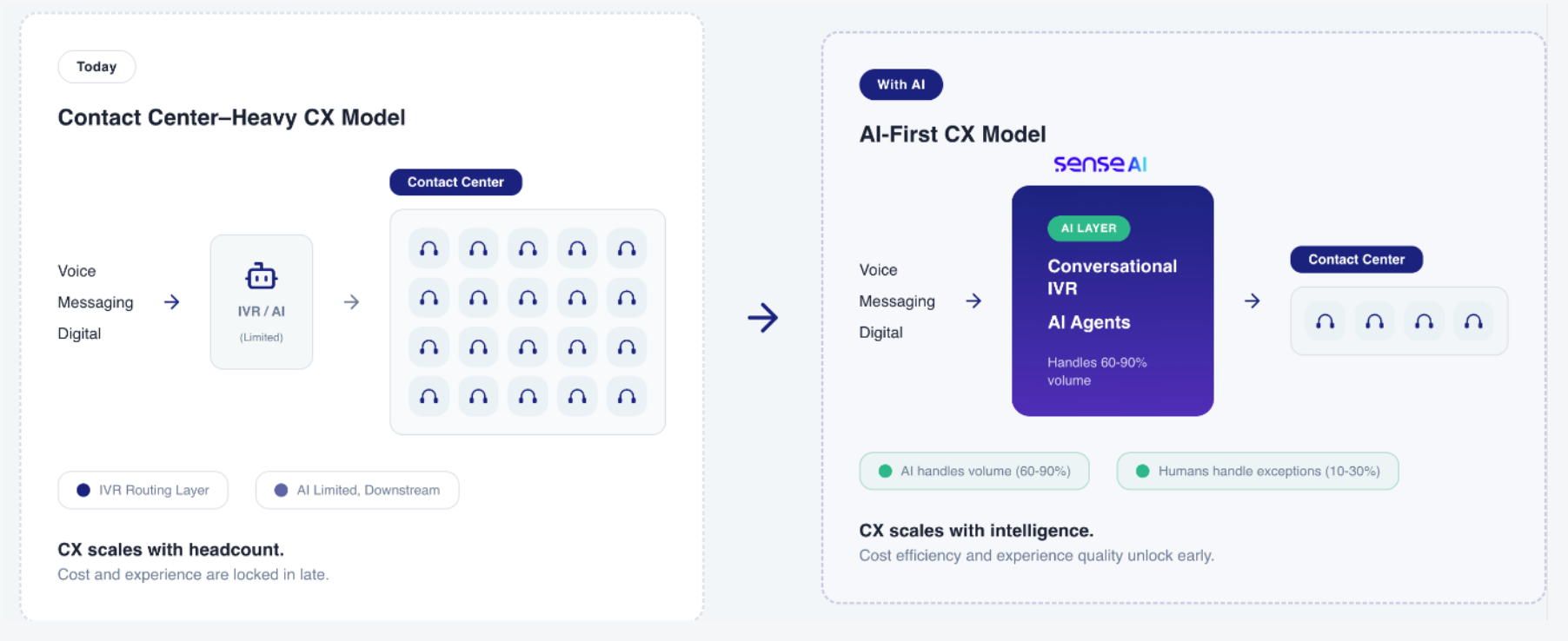
Sense AI is designed around this architectural rethink - simplified for telecom operators and adaptable across the broader enterprise landscape. The solution architecture remains consistent across industries; what changes is how it aligns with each organization’s strategy.
Rather than adding AI as a productivity layer inside the contact center, Sense AI moves intelligence upstream into the first point of contact across voice and digital channels. Conversational IVR and AI agents are positioned as the primary resolution layer, not a handoff mechanism.
This enables automation to:
- Execute multi-step, multi-service flows
- Apply business rules and guardrails
- Resolve interactions end-to-end before escalation is considered
Crucially, Wavenet’s Sense AI treats escalation as a governed outcome, not a default path. When human intervention is required due to complexity, risk, or empathy - it happens with full context preserved across IVR, AI, human agents, and outbound follow-up.
But Sense AI goes beyond the interaction layer and sits in the emerging Autonomous CX / AI Workforce category - the layer above traditional CCaaS and conversational AI. While platforms like Genesys and NICE manage the contact center, Sense AI focuses on automating the work required to resolve customer journeys end-to-end within a scalable, agentic architecture.
It fills the gap that remains after the interaction ends by using AI agents to:
- Complete tasks and execute workflows across systems
- Assist agents in real time when human intervention is required
- Reduce manual back-office effort that drives hidden cost-to-serve
This positions Sense AI as the missing layer in the enterprise-grade CX stack, directly improving cost per contact, first-call resolution, and handling time by turning contact centers into an AI-powered workforce engine.
In this sense, Sense AI is less about adding AI to the contact center and more about redefining what the contact center is responsible for; enabling enterprises to decouple CX quality from headcount growth and move toward an AI-first, exception-driven model of customer resolution.
The Future of Enterprise Contact Centers
Enterprise AI and agentic architecture are not incremental upgrades. They represent a shift from human-centric resolution to human-like AI-first resolution, where human expertise becomes the exception layer.
Organizations that embrace this shift will move beyond managing interactions and toward engineering resolution at scale.